
AAA released its Thanksgiving travel forecast today: 81.5 million Americans are expected to travel at least 50 miles from home between Tuesday, Nov. 24, and Monday, Nov. 30. Dallas-Fort Worth is No. 10 among the domestic destinations most booked by AAA members, partly because of the Thanksgiving Day football games (AAA, Nov. 16, 2026).
And it's not just people flying in. Fort Worth-based American Airlines expects to carry more than 8 million travelers between Nov. 19 and Dec. 1, and Sunday, Nov. 29, is set to be its busiest day of flying since the pandemic (WFAA, Nov. 9, 2026).
In Forney, Mesquite and across the Metroplex, that means two things. A lot of families will spend a few nights in hotels or at relatives' homes, and a lot of others will have guests sleeping in the spare room or on the couch. That's exactly how bed bugs get around.
Why Thanksgiving bed bugs show up in December
The U.S. Environmental Protection Agency (EPA) puts it plainly: bed bugs are "great hitchhikers." They move from an infested place to a new home in luggage, clothing, boxes, furniture and bedding (EPA).
The catch is that you almost never notice them right away. According to the EPA, a female lays 1 to 3 eggs a day, and the egg-to-egg cycle can take four to five weeks under favorable conditions (EPA). A few bugs that ride home in a suitcase on Nov. 30 can go unnoticed until December or January, when someone in the house starts waking up with bites.
Bites are misleading, too. The EPA says they're a poor indicator, because they can look like mosquito bites or a rash, and some people don't react to them at all (EPA).
Our take: the moment to stop the problem is when you get home, before the suitcase goes into the bedroom. After that, it gets harder.
This week's cold doesn't slow them down
Monday started with the coldest temperatures of the season so far in North Texas, with lows that could dip into the 30s in some areas Monday night (CBS Texas, Nov. 16, 2026). On Sunday, DFW Airport topped out at just 51°F (NWS Fort Worth, climate report for Nov. 15).
Bed bugs don't care. They live indoors, next to people. The EPA says they stay active at temperatures as low as 46°F and can survive several months to a year without feeding (EPA). In a heated house, winter doesn't stop them.
Sleeping away from home: five minutes when you arrive
Before you unpack at the hotel or at your relatives' place:
- Check the luggage rack. The EPA recommends inspecting it in hotel rooms.
- Pull back the corner of the sheet and look at the mattress. Check the seams, piping and tags, and the cracks in the headboard (EPA).
- Look for the signs that actually matter: rusty or reddish stains on sheets or the mattress, small dark spots that bleed into the fabric like a marker, and the tiny skins young bed bugs shed as they grow.
- Keep your suitcase closed and away from the bed while you check. If you find something, ask for a different room away from that one.
Coming home: the suitcase stays out of the bedroom
This is the step that matters most:
- Unpack in the garage or the laundry room, not on the bed.
- Run all your travel clothes through the dryer on high heat. The EPA confirms a dryer on high heat can kill bed bugs. Carry the clothes to the laundry in closed plastic bags.
- Vacuum the suitcase, especially seams and pockets. Seal the vacuum bag tightly and throw it out right away in an outdoor trash can, as the EPA recommends (EPA).
- Items you can't wash can go in the freezer in a sealed bag, but that only works if the freezer holds 0°F for three days. The EPA warns that many home freezers don't get that cold, so use a thermometer.
If you're hosting
When your guests leave, strip the spare bed or sofa bed, wash and dry the sheets on high heat, and check the mattress seams and the cushions. A good-quality, light-colored mattress encasement removes hiding spots and makes bed bugs easier to see (EPA).
What not to do
- Don't count on bug bombs. The EPA explains that the spray doesn't reach the cracks where bed bugs hide, and that misused foggers can harm your health or start a fire.
- Don't try to heat the house with the thermostat, a space heater or the fireplace. The EPA says it doesn't work and is dangerous.
- No rubbing alcohol, gasoline or kerosene. They can ignite with a spark (EPA).
- Don't move to another bedroom or the couch. Bed bugs follow people: the EPA says they'll readily travel 5 to 20 feet from their hiding spots to feed (EPA). You can end up with two infested rooms instead of one.
The EPA also acknowledges that treating bed bugs is complex and can take weeks to months, depending on how far they've spread. And it adds that treating a small infestation is far easier and less costly than treating one that has spread (EPA).
What we do at Exodo
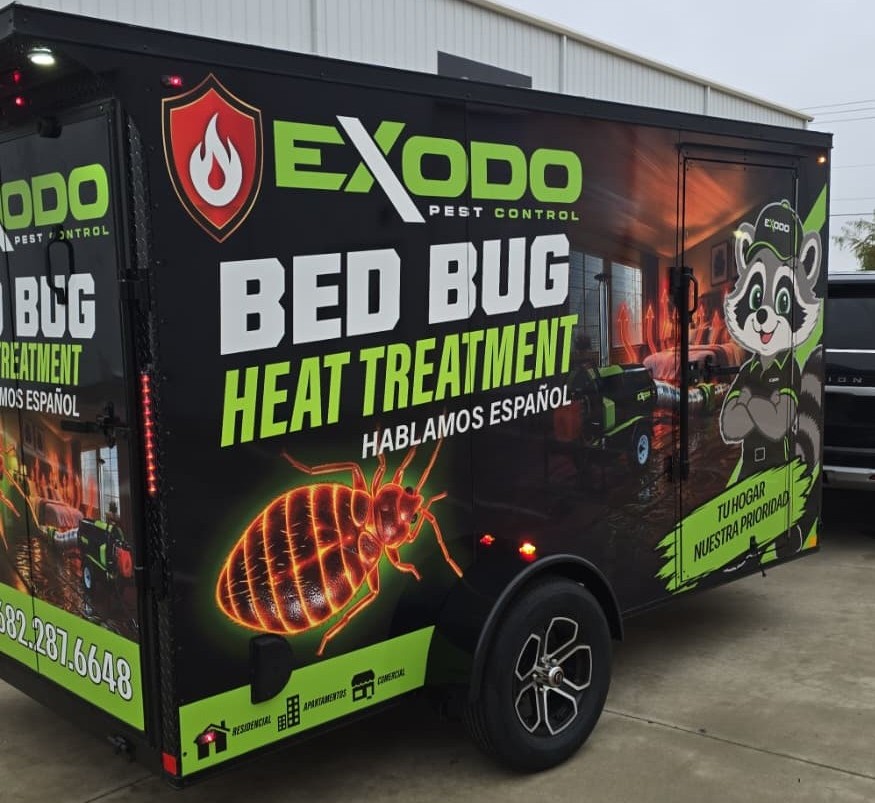
If you find signs after a trip, send us photos or give us a call. Inside DFW, bed bug inspections are free. Then we recommend the option that makes sense for your home:
- Chemical and heat treatment options: Call us for a quote. We use EPA-registered products, applied according to the label, or heat treatment that raises the room temperature to 140°F to kill every stage of the bed bug.
Before we schedule, we give you a prep sheet, and you get your quote in writing before we start. See the details on our bed bug heat treatment page.
We serve the whole Metroplex, especially Forney, Mesquite, Rockwall, Terrell, Kaufman, Garland and Dallas.
And if the noise you hear at night is coming from the attic instead of the bed, read our post on why rats are moving into DFW homes this time of year.
Before you travel, or as soon as you're back
Call or text us at (682) 287-6648, or request your inspection on our contact page. We answer in English or Spanish.
Follow us for real cases and seasonal tips on TikTok, Instagram and Facebook.
Exodo Pest Control LLC | TPCL #0921358